You’ve listed your property on Airbnb? Hurray! The photos are live, bookings are coming in, and your calendar finally looks promising. The hard part is over – now the fun begins. There are so few things that turn an optimal listing into a great experience (for your guests and yourselves) like a well-thought-out house manual does.
What separates a basic rental from a memorable hospitality brand is the guest experience, and it’s not just about being “tech-savvy”.
The Problem:
There is a certain kind of friction that occurs about fifteen minutes after your guest checks in to your Airbnb. The initial "wow" of the novelty has faded, and the practicalities of living in a stranger’s home have set in.
They can’t find the Wi-Fi password. They don’t know how to start the induction stove. Which local food joint actually lives up to the hype. Or what the checkout instructions are. The difference between a smooth stay and a frustrating one often comes down to how easily guests can find information after check-in.
For years, hosts relied on printed welcome binders or static PDFs. But modern travelers expect something faster, cleaner, and mobile-friendly.
That’s why more Airbnb hosts and professionally managed homestays are switching to digital guidebooks.
A digital Airbnb guidebook doesn’t just improve the guest experience. It reduces repetitive guest messaging, keeps property information updated in real time, and helps hosts run their listings more professionally.
In this guide, we’ll break down why every host needs a digital guidebook — and three practical ways to make yours stand out.
Why Traditional Airbnb Welcome Binders No Longer Work
Guests need answers quickly, and hosts are often stuck responding to the same questions repeatedly. And while occasional guest interaction is part of hospitality, constant operational questions quickly become time-consuming — especially for hosts managing multiple listings.
The primary flaw with traditional binders is its permanence. The moment a door code changes, or a local cafe closes, your printed manual becomes inaccurate. Static PDFs also have the same issue. They’re difficult to update and often buried inside booking platform messages that guests rarely revisit.
The new age traveler lives on their phone. They expect instant access without the friction of downloading another app or searching through message threads.
This is why a digital guidebook becomes essential.
What makes a digital guidebook better?
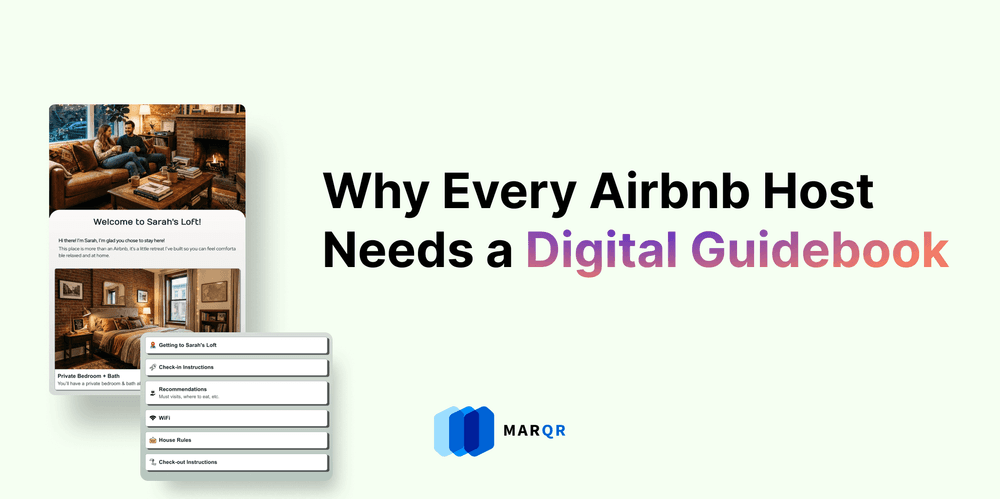
A modern digital guidebook acts as a centralized guest dashboard that hosts can update anytime.
Instead of sending multiple PDFs, messages, and links, hosts can organize everything into one clean mobile experience:
- Check-in instructions
- Wi-Fi details
- Appliance guides
- House rules
- Local recommendations
- Emergency contacts
- Checkout instructions
With Marqr, hosts can create a ‘Link in Bio’ style guidebook that guests can access instantly through a QR code, direct link or an Apple Wallet Pass.
Unlike proprietary guest apps that travelers rarely want to download, a browser-based guidebook removes friction completely. Guests simply tap the link and access everything they need.
More importantly, the guidebook stays dynamic. So whether you need to update a smart lock code, add a seasonal recommendation, or edit checkout instructions, you can update the information in seconds without reprinting manuals or resending PDFs.
Guests always see the latest version.
For Airbnb hosts, homestay owners, and boutique vacation rentals, this creates a more professional guest experience while reducing operational overhead.
Recommended Reading: Airbnb Superhost tips to improve guest experience
3 ways to make your guidebook stand out
1. Reading the Room: The Analytics of Hospitality
Most hosts only learn that guests are confused when they message them. By then, the "friction" has already set in.
Marqr’s digital guidebook changes that.
One of the biggest advantages of Marqr is the ability to move from reactive to proactive hosting through scan and link-click analytics.
Instead of guessing what guests struggle with, you can see exactly which information they access most often.
If you notice a spike in clicks on your "Parking Instructions" link routinely at 6:00 PM, the data is telling you that your physical instructions are likely unclear.
Data like this helps hosts identify friction points inside the property experience.
Over time, your guidebook becomes more than a resource hub — it becomes a feedback loop that helps improve your operations.
For small hospitality businesses, this kind of guest behavior insight is incredibly valuable.
2. Privacy Without the Paper Trail: Securing the Airbnb Listing
Many hosts hesitate to digitize their property manuals because they worry about security.
And that concern is valid.
You may not want alarm instructions, smart-home settings, or owner-specific operational details floating around in downloadable PDFs or unsecured email threads.
A well-designed digital guidebook solves this problem by giving hosts more control over access.
With Marqr, hosts can securely link password-protected or non-downloadable documents directly inside their guidebook. Guests can access important information when needed, without permanently downloading or sharing sensitive files.
This creates a balance between convenience and security:
Guests get instant access to instructions
Hosts maintain control over sensitive information
Property operations stay organized and professional
For professionally managed homestays and boutique rentals, this is especially important as smart-home technology becomes more common.
3. Use QR Codes to Create a Frictionless Guest Experience
The best digital guidebooks don’t force guests to search for information. They place information exactly where guests need it.
That’s where QR codes become powerful.
Instead of printing long instructions throughout the property, hosts can place simple QR codes in key locations:
On the refrigerator for kitchen instructions
Near the entryway for check-in and lock information
Beside appliances for troubleshooting guides
On bedside tables for Wi-Fi access and local recommendations
Guests scan the code and immediately access the relevant section of the guidebook.
This creates a 24/7 self-service experience without removing the personal touch of hosting.
More importantly, it reduces repetitive messaging for hosts.
Instead of answering the same operational questions multiple times a week, your guidebook handles them automatically.
The Future of Airbnb Hosting Is Digital
A digital guidebook isn’t just about replacing a printed binder.
It’s about creating a smoother, more professional hospitality experience for both guests and hosts.
For guests, it means faster answers, easier navigation, and less friction during their stay.
For hosts, it means fewer repetitive messages, easier updates, stronger branding, and more scalable operations.
As short-term rentals become increasingly competitive, the guest experience matters more than ever. Small operational improvements — clearer communication, easier access to information, faster troubleshooting — directly impact reviews and repeat bookings.
The hosts who stand out are no longer just offering a place to stay.
They’re building hospitality brands.
And a well-designed digital guidebook is one of the simplest ways to start.