Your company's sales, marketing, and customer assets build the fabric of user experience. Whether it’s a product catalog, proposal, menu, or lead magnet, once you release it in to the world (wide web) it gains a peculiar autonomy. It can be forwarded, copied, reused, or even republished without your consent.
This is not just an inconvenience. It is a huge risk. Protecting your digital assets is, therefore a top priority for creators and businesses alike.
The good news is that there are tried and tested ways to restrict PDF downloads. The bad news, however, is that not all of them work nearly as well as you’d think.
In this blog, we’ll delve into the details on what works, what only appears to work, and how modern marketing and digital asset management tools like Marqr's PDF QR changes the game.
Why should you prevent PDFs from being downloaded?
Let's be real: a downloaded PDF is a loose cannon. Once it leaves your brand's ecosystem, you lose visibility as to who accesses it (and when and how often), who it gets shared with, and what sensitive and proprietary content is getting leaked out of your funnel.
Preventing downloads is less about paranoia and more about the opportunities for access management, monetization, and engagement data.
Here are the key reasons why businesses (should) restrict PDF downloads:
Protect Intellectual Property
Prevent unauthorized copying or redistribution of proprietary content like frameworks, pricing, or internal documents.
Gate Premium or Exclusive Content
Ensure only qualified or paying users can access high-value resources, maintaining their exclusivity and perceived worth.
Manage end-to-end distribution
Control who can access your documents, for how long, and under what conditions—even after it has been shared.
Track engagement
Gain visibility into who is viewing your content, how often, and what they’re interacting with to inform better decisions.
What is Digital Access Management?
Digital Access Management, or DAM, is more than a technology; it is a philosophy of restraint: it governs who can access a file, controls what they may do with it, and how long that permission lasts.
In the context of documents, DAM transforms a static PDF into a managed experience—one where viewing, copying, printing, and downloading can be permitted, restricted, or revoked altogether.
At its best, DAM does not choke distribution; it provides the guardrails for it, allowing the content to move through the funnel, but not to escape.
Real-World Use Cases for PDF Protection
The appeal for document control emerges most clearly in professions where the value of a file exceeds its format.
Retailers:
Retailers circulate lookbooks, vendor agreements, pricing catalogs—documents that are both commercially sensitive and widely shared. A leaked pricing sheet can ripple through supplier relationships; an early campaign concept can surface in a competitor’s window display.
Marqr offers retailers a way to circulate necessary information without surrendering strategic advantage.
Restaurants:
Restaurants, especially those scaling into franchises or multi-location brands, rely on standardized documentation: recipes, sourcing guides, and operational manuals. These are intellectual property disguised as instruction.
Controlled PDFs ensure that proprietary processes remain within the intended circle, even as expansion and staff turnover complicate access.
Consultants & Freelancers:
For consultants, often the deliverable is the product. A strategy deck, a research report, a market analysis—these are assets that can be reused, redistributed, or quietly passed along without attribution or fair compensation. DAM allows independent professionals to share insights while preserving ownership, ensuring that their work does not become anonymous infrastructure.
Marketing Agencies:
Agencies operate in a paradox: they must share extensively with clients, yet protect the very ideas that distinguish them. Campaign blueprints, brand frameworks, media strategies—these documents are both collaborative tools and proprietary thinking. Controlled access helps agencies maintain this delicate balance, offering transparency without forfeiting control.
How to disable document download
The instinct to “lock” a PDF often begins with a simple question: how do you stop someone from downloading it? The answer, unfortunately, is that you rarely stop them entirely—you merely make it harder, or easier to trace.
Still, there are methods, some more effective than others:
1. Native PDF Restrictions (Password Protection + Permissions)
This most easy and commonly used approach to securing PDF documents is to apply a password to the PDF and restrict actions like downloading, printing, or copying within the file itself.
While it’s easy to implement and widely accessible, it offers only surface-level protection— since recipients who gain access can just as easily bypass restrictions using external tools or still circulate the file.
2. Hosting the PDF in a Web Viewer like Google Drive
Instead of sharing the file directly, you embed the PDF in a browser-based viewer like Google drive and remove download options. This creates a more controlled viewing experience and reduces casual downloads.
However, it’s not foolproof. Users can still access the file through developer tools or cached files. And moreover, you lose engagement analytics regarding when the document was accessed and how many times was it done so, and from where.
3. Use Access-Controlled Platforms like Marqr
Among available tools, Marqr stands out because it doesn’t just protect files—it controls access at the source. The document is never directly shared—instead, users view it within a protected environment where downloads, access, and engagement can be tracked.
This offers the highest level of control, especially for sensitive or high-value content.
How Marqr’s PDF Protection Works
More advanced systems approach the problem differently. Rather than securing the file itself, they secure the experience of the file.
Marqr’s model treats a PDF less like a downloadable asset and more like a hosted environment. The document is viewed through a controlled interface, where permissions are enforced in real time, and user behavior can be observed. In this paradigm, the file never truly leaves its point of origin.
Password Protection
Access begins, predictably, with authentication. Users must verify their identity before viewing, ensuring that documents are not casually passed along to unintended recipients. But unlike static passwords, this layer can be dynamic — tied to emails, sessions, or specific users.
Learn How to Password Protect PDF Documents on Marqr
Disable Downloads
The more consequential feature is the ability to disable downloads entirely. Users may view the document, but cannot save it locally.
This does not eliminate all forms of duplication—screenshots remain stubbornly analog—but it significantly reduces casual redistribution.
Tool Tip: Click on the ‘Disable document download’ toggle, to prevent users from downloading the PDF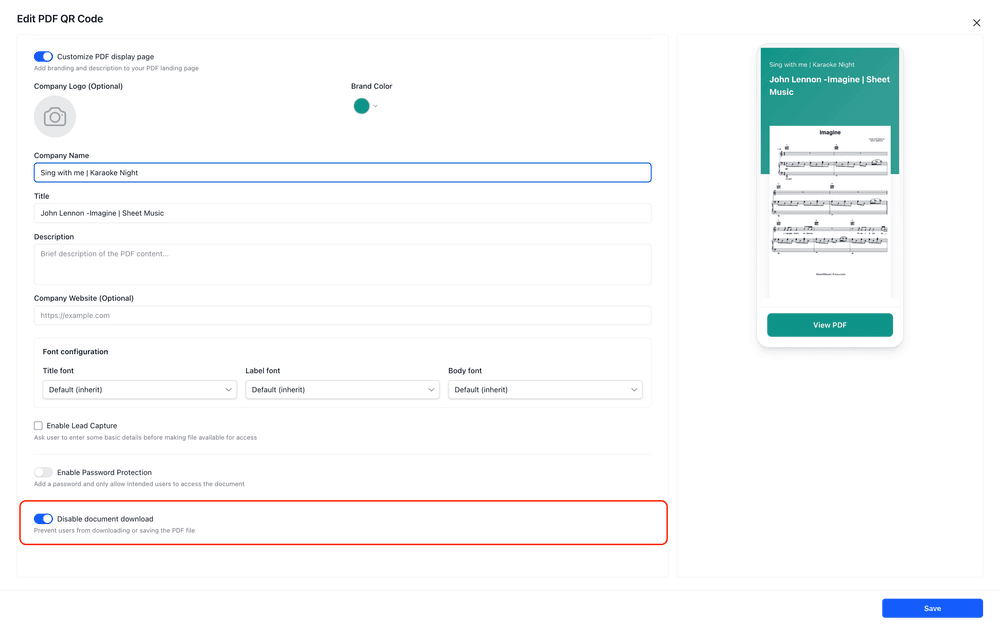
View Analytics
Control, in this context, is inseparable from visibility. Analytics reveal who accessed a document, when, and for how long. Patterns emerge: which pages hold attention, where readers drop off, who return repeatedly. A PDF becomes not just a container of information, but a source of insight.
Learn how Retailers use these 5 QR Code Stats
Lead Capture
Finally, there is the subtle alchemy of turning readers into prospects. Before accessing a document, users may be prompted to provide contact details. The PDF, once a static endpoint, becomes an entry point into a broader relationship—part content, part conversation.
Learn how to collect leads with Marqr’s Lead Magnets
Conclusion
In the end, document protection is not about paranoia; it is about proportion. Not every file requires fortification, but those that do deserve more than an on-file password and hope.
That’s exactly what platforms like Marqr are built for. Instead of asking “How do I stop downloads?”, the better question becomes: How do I control access from the start?
Once you shift that perspective, protecting your documents becomes far more effective—and far more measurable.